
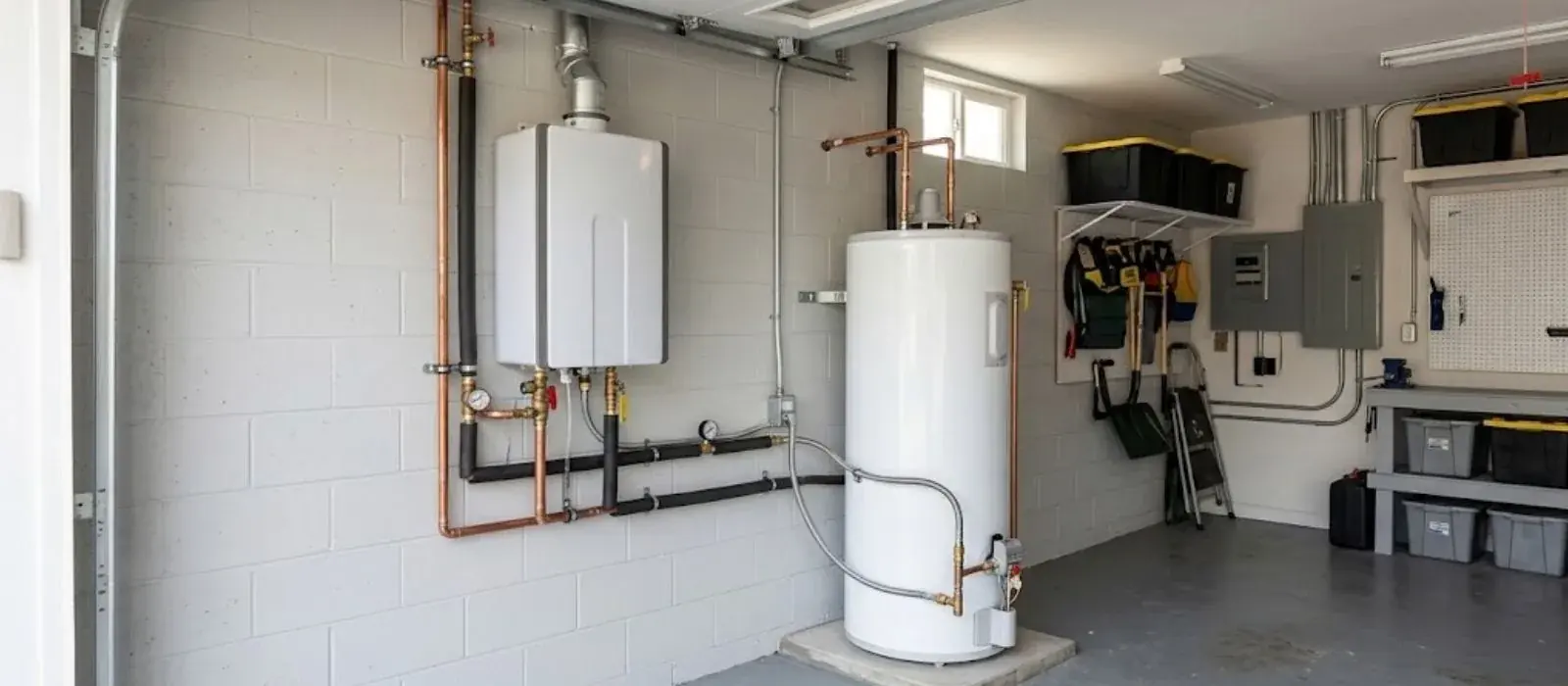
Why heated water needs room
Water expands when it is heated. In an open system, that extra volume flows back toward the street. In a closed system, a check valve or pressure regulator blocks the way back, and the pressure inside the house rises with every heating cycle.
Without a place for that pressure to go, relief valves weep, faucets drip and fixtures wear faster. An expansion tank is a small vessel with an air cushion that absorbs the extra volume.
Is your system closed
- A pressure reducing valve at the main often makes the system closed.
- A backflow preventer or check valve at the meter does the same.
- A new meter setup may have added a check valve without you knowing.
- Older homes may be open if no valve is present.
A plumber can test this with a pressure gauge and a hot water cycle. If pressure climbs well above normal after the heater runs, expansion is a problem.
What changes with a tankless heater
A storage tank heater has a large volume that takes up some expansion on its own. A tankless unit holds only a small amount of water, so the pipes carry the load. That is why installers often add an expansion tank when a tankless unit replaces a tank in a closed system.
Some manufacturers require one in closed systems. Check the installation manual for your model, because skipping a required part can affect the warranty. Our tankless water heater page covers the rest of the install.
Symptoms of a system that needs one
| Sign | What it points to | Fix. |
|---|---|---|
| Pressure relief valve drips | System pressure above the valve rating | Test pressure, add an expansion tank. |
| Faucets drip after the heater runs | High pressure at fixtures | Check regulator and tank. |
| Banging when valves close | Water hammer or pressure spikes | Inspect arrestors and pressure. |
| Frequent fixture failures | Constant overpressure | Install tank, replace parts. |
None of these signs prove the diagnosis. A gauge reading does.
What we see around Los Lunas
Many Los Lunas homes connect to the village water system through a meter, and some have pressure regulators installed by the original builder. A house in a newer subdivision is more likely to be closed than an older one in Belen.
If you are converting an older home with a tank to a tankless unit, ask for a pressure test before the install. It takes minutes and avoids a return trip.
Sizing and installing the tank
Expansion tanks are sized by the volume of the system and the water pressure. The tank is pre-charged with air to match the line pressure, and the plumber sets that charge before connecting it.
The tank is installed on the cold supply line near the heater. It should be supported, since a full tank is heavy. If your home already has an expansion tank, ask the installer to test it too, because a failed tank acts like a missing one.
How to measure house pressure
A pressure gauge that screws onto a hose bib costs little and tells you what the house sees. Attach it to an outdoor spigot or the washing machine valve, open the valve and read the dial. Normal household pressure sits in a middle range, and anything near the relief valve rating is a warning.
Check it twice. Read it once with the water heater idle, then again after the heater has run for a while and no water has been used. If the second reading is much higher, thermal expansion is the cause.
What an expansion tank looks like and how it is set
A small expansion tank looks like a squat metal cylinder with an air valve on top, similar to a tire valve. Inside a rubber diaphragm separates air from water. As pressure rises, the water pushes into the tank and compresses the air.
The air side must match your house pressure. A plumber sets it with a tire gauge and a hand pump before connecting the tank. If you install one yourself without setting the charge, the tank will not do its job.
When a relief valve is a sign, not a nuisance
The temperature and pressure relief valve on a heater is a safety device. If it drips regularly, do not cap it. Capping a relief valve removes the last safeguard on a hot water system.
A dripping valve is information. It may mean thermal expansion, a failing valve or high incoming pressure. Test the pressure first, then replace the valve or add a tank as the readings show. A plumber can do both in one visit.
Cost of skipping the tank
Ignoring thermal expansion has a price. Relief valves wear out, fixtures fail early and supply lines burst under repeated pressure swings. A small tank is a minor part compared with the damage it prevents.
If a plumber tells you a tank is optional in your system, ask why. The answer should refer to a measured pressure and an open system, not a guess.
Questions to ask the installer
- Have you measured the house pressure before and after heating?
- Is there a pressure reducing valve or backflow preventer on the main?
- What does the manufacturer say about expansion in closed systems?
- Where will the tank be mounted and how is it supported?
- Who sets the air charge and how is it recorded?
These five questions sort a careful installer from a hurried one. A short answer of yes or no without numbers is not enough.
Maintenance of the tank
An expansion tank needs little care, but check the air charge once a year. Press the valve with a gauge. If water comes out, the diaphragm has failed and the tank needs replacing.
Tanks mounted upside down or unsupported fail sooner. Have the plumber mount it upright on a bracket.
Relief valve safety checklist
- Never cap or plug a relief valve discharge line.
- Keep the discharge pipe pointed to a safe drain location.
- Lift the test lever once a year and confirm water flows and stops.
- Replace a valve that keeps dripping.
- Call a plumber if the drip comes with high pressure readings.
The Uniform Plumbing Code (UPC) requires relief protection on water heaters for good reason. A relief valve is the last safeguard when everything else fails.
Expansion tank questions
No. It depends on whether your system is closed and on the manufacturer’s instructions.
A plumber checks with a gauge. A pressure reducing valve or backflow preventer is a clue.
Yes. A waterlogged tank no longer absorbs pressure. A plumber can test it.
Commonly on the cold supply to the heater. Follow the manual.
Yes. See Rio Communities.